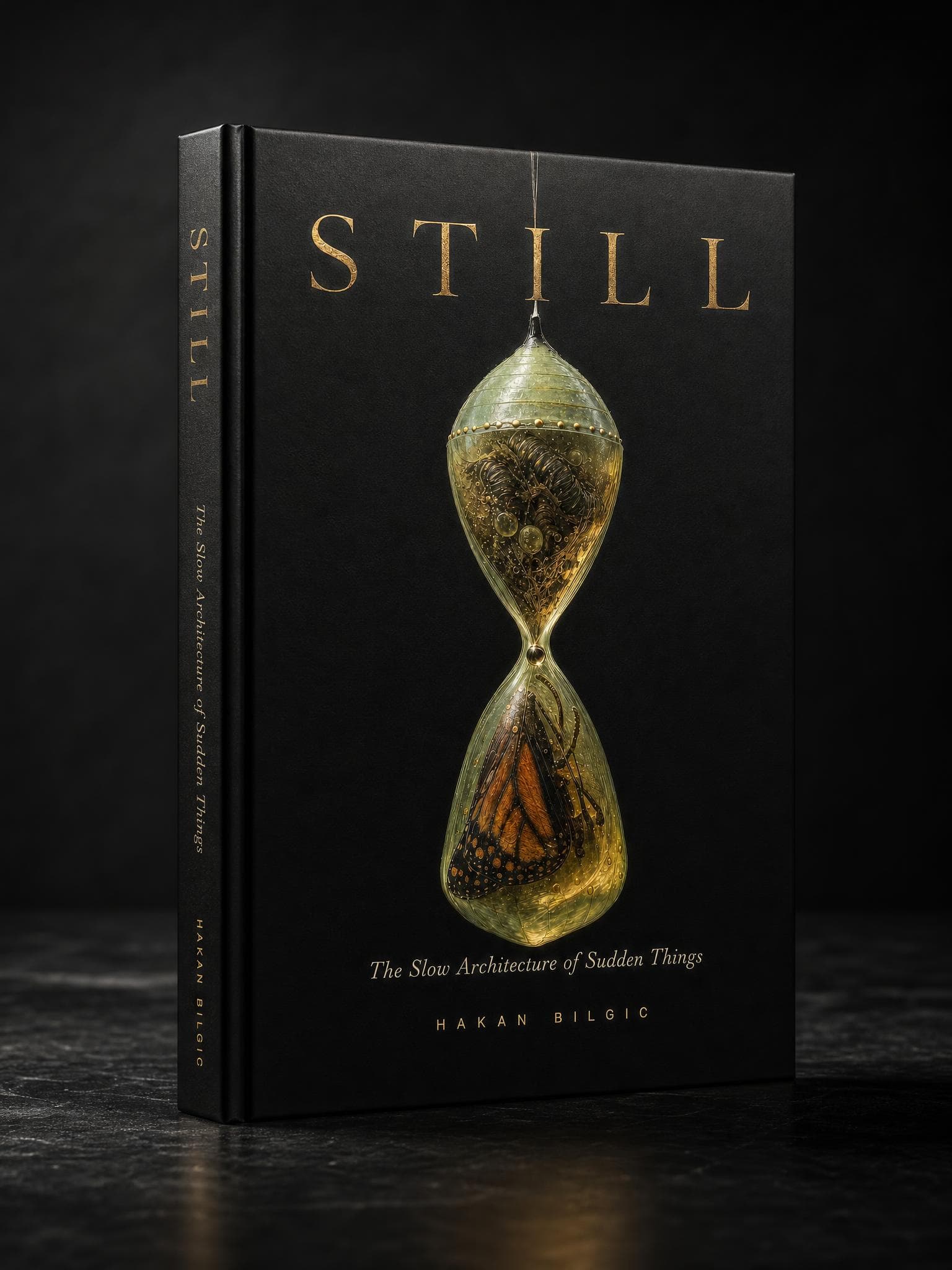
What this book is about
Most of what happens in the world that matters happens twice. First, in public, loudly: the dateable event, the thing the camera records. And once before that, quietly, over months or years or decades, inside the artery, the mind, the relationship, the chart, the country. The first kind of moment is what people remember; the second kind is what makes the first kind possible.
STILL is about the second kind.
Across forty-one chapters and five domains (Body, Mind, Love, World, History), the book shows that the neuron at threshold and the civilization at threshold are running, at radically different scales, the same essential process: pressure accumulating against a barrier, a system holding its loaded state at metabolic cost, and a trigger wildly disproportionate to what it unleashes, because what it unleashes was already present.
The boring part is the part with the information.
The argument
We have a strong cultural preference for events. We organize our histories around the day the war started, the day the company collapsed, the day she walked out, the day the diagnosis came, and we treat those days as causes. They are almost never causes. They are releases of something that had been completing itself, often for years, beneath the surface of an apparent stillness the world had been misreading as nothing happening.
That is what this book is calling consolidation: the slow, often invisible phase in which something is being stored. What gets stored varies by domain: pressure in a fault line, charge across a neuron, antibodies in a blood test ten years before a diagnosis, capability in a career exile, grievance in a province, attachment in a marriage, pathology in a brain that still works, capital in a chart that has gone flat. The event happens later. The information about what will happen, and how, is being written now.
The argument running through every chapter is that consolidation is fractal. The two milliseconds inside a single neuron, the eighteen months of new-relationship neurochemistry, the twenty-seven years of Nelson Mandela's imprisonment, the eight hundred years of strain on the Cascadia fault, and the four hundred million years a coelacanth has been a coelacanth are all running, at radically different scales, the same architecture.
Five parts. One pattern.
Body. Mind. Love. World. History.
Part I: The Body
What consolidation does to flesh: the action potential, the sexual response plateau, the chrysalis, addiction, cancer dormancy, autoimmunity, and the twenty-year prodrome of Alzheimer’s.
Part II: The Mind
What the brain stores, blocks, breaks, prunes, and rebuilds: sleep and memory, the incubation of insight, the learning plateau, adolescent pruning, and trauma.
Part III: Love
What consolidates between two people: the neurochemistry of early limerence, the renegotiation of year three, the documented slow exit, the affair as the surfacing of a rupture that had already happened, and the persistent neural model of someone who is gone.
Part IV: The World
What consolidates in markets, careers, systems, and the ground itself: institutional accumulation in flat charts, career exile, scientific winters, pandemic reservoirs, and the silent storing of seismic strain.
Part V: History
The longest pauses: twenty years of a hidden theory, twenty-seven years of a prison cell, decades of pre-revolutionary pressure, two thousand years of a dormant language, and four hundred million years of a species that did not change.
Core themes
- →Energy accumulates during apparent stasis; stillness is rarely empty.
- →Triggers are not causes. The match finds tinder, and the readiness was the consolidation.
- →Pressure is loaded, but outcome is not. The same accumulation can resolve upward or downward depending on conditions present in the surrounding system.
- →Consolidation is fractal: milliseconds and millennia run the same architecture.
- →The window for influence is during the quiet phase, not after the trigger.
Each chapter
Each chapter opens with a real, documented person inside the consolidation: Marcus Luttrell on the mountain, Frida Kahlo painting from a bed, Geoffrey Hinton through two AI winters, Eliezer Ben-Yehuda raising the first native Hebrew speaker in nearly two millennia. Each chapter answers three questions: what is being stored, what breaks the silence, and what determines whether the resolution is upward or downward.
The book closes by handing the reader the same three questions, applied to whatever consolidation they are currently inside and have not yet named.
Who this is for
Readers of long-form non-fiction in the tradition of The Body Keeps the Score, Sapiens, Thinking in Systems, The Hidden Life of Trees, and How Emotions Are Made: readers who want a single conceptual lens that reorganizes phenomena they already half-recognize across biology, psychology, relationships, markets, and history.
A glimpse inside
“The first kind of moment is what people remember. The second kind is what makes the first kind possible. And almost no one watches it. This book is about the second kind.”
“Pressure is loaded; outcome is not. The trigger ends the silence. What the silence had been storing, and what the world surrounding it does in response, determines what comes through.”
“The pause is not the absence of the story. The pause is where the story is being written.”
Read the pause.
One purchase. The ebook, yours forever.